
The name is the pitch
ماشي
Mashi is Egyptian for “okay / got it / that works”. It’s one of the most-used words in the country, it’s in almost every conversation, and you will not find it in a Modern Standard Arabic textbook. That gap is the whole reason this app exists.
Why only Ammiya
Almost every Arabic course ever made teaches Modern Standard Arabic — Fus-ha. It is the language of newspapers, formal speeches and official documents, and it is nobody’s mother tongue. You can study it for two years, land in Cairo, and not understand the taxi driver.
Egyptian Arabic — Ammiya — is what’s actually spoken: in homes, in cafés, in the films and music that made it the dialect understood from Morocco to the Gulf. Egyptian cinema did for this dialect what nothing else did for any other.
So Mashi teaches Ammiya, and only Ammiya. Not a bit of both. Not MSA with a dialect module bolted on at Level 4.
Every word is a person, not a synthesiser
There are 1,789 recordings live in the app, made by native Egyptian teachers with more than 25 years of teaching experience. There is no text-to-speech and no browser speech synthesis anywhere in the curriculum, at any level, on any platform.
That covers, with one recording per spoken form, every noun in singular and plural, every adjective in masculine, feminine and plural, every sentence, every themed item, and all 1,400 verb-conjugation forms — eight pronouns for every one of the 175 verbs. It is the slowest, least glamorous part of building a language app, and it is the part that decides whether you can actually be understood when you open your mouth.
The syllabus is public before you pay
Most language apps won’t show you what you’re buying until you’ve bought it. All forty of our lessons are listed, with the vocabulary and the verbs each one teaches. Read it, decide, and hold us to it.
Built with teachers, for teachers too
The curriculum was written, and every recording made, by native Egyptian teachers with more than 25 years of teaching experience. The app gives any teacher a way to use it with a real class: share a join code or invite link, approve who joins, set homework from any lesson, message the class, and read class and per-student reports.
No separate app, nothing to install twice. And a teacher whose students subscribe earns 10% of what they pay. More on the teacher portal. Buying for a whole team or school? Organization plans.
And then there is Sobek

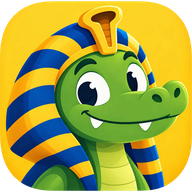
The crocodile in the pharaoh’s headdress is named after the Nile’s own crocodile god. He is the app icon and he greets you on the welcome screen. He is not a streak-guilt machine. He never tells you he is sad that you missed a day.
Designed to be Egyptian, not a clone
The app has hard rules about what it will not do, because the easiest thing in this category is to copy the market leader:
| Mashi | Instead of |
|---|---|
| A continuous Nile with location stops | a zigzag path |
| A yellow primary button | green |
| A crocodile in a pharaoh’s headdress | an owl |
| XP, and only XP | coins and gems |
| Bead segments for quiz progress | a progress bar |
| Shape-built Egyptian illustration | emoji and clipart |
And your felucca — the Nile boat you customise when you sign up — is your avatar, your position on the map, and the thing that races other learners every week.
What we won’t put on this page
Mashi launched in August 2026. It is weeks old. That means there are no download counts worth quoting, no meaningful star rating and no testimonials — so you won’t find invented ones here, or a “10,000+ learners” badge under a brand-new app.
What we can put in front of you is everything that has actually been built:
Proof of substance beats proof of popularity —
and it’s the only one
we’ve earned yet.
Mashi is on the App Store and Google Play
The first three lessons of the level you pick are free, on iPhone, iPad and Android.